

Best Mushroom Supplement Brands: How to Pick One by the Label
By the Utoya Wellness team · · 9 min read

Quick answer
The best mushroom supplement brand is the one whose label names the species in Latin, says fruiting body, states an extract ratio, discloses the amount per serving, shows batch lab results, and avoids mycelium-on-grain filler. Utoya Wellness Mushroom Blend meets those marks as one option: 23 mushrooms in two capsules, 1,160 mg per serving. Look elsewhere if you want one species at a high dose, coffee, gummies, or powder.
The short answer: pick a brand by what is on the label, not the front of the bottle
A good mushroom brand tells you exactly what is inside, and you can check it in about two minutes.
Run every bottle through the same five checks. Are species named in Latin? Does it say fruiting body? Is there an extract ratio such as 10:1? Is the amount per serving shown for each mushroom, not just one total? Can you see a lab report for the batch? If any answer is no, move on. Mushroom Blend is one option that passes these checks. If you want a single species at a high stated dose, a coffee, gummies or a powder, a different product will suit you better.

Compare brands on six criteria (table)
The same criteria apply to every product type, and each type wins in some places and loses in others.
| Criterion | Single-species extract | Multi-mushroom blend (capsule) | Mushroom coffee | Gummies | Powder |
|---|---|---|---|---|---|
| Extract or raw powder (and ratio) | Often extract. Look for a stated ratio. | Mixed. Check each line for a ratio. | Usually extract, often a small amount. | Varies. The ratio is often not stated. | Either. Raw powder is less concentrated than extract. |
| Fruiting body or mycelium on grain | Best brands say fruiting body. | Check each line for the part used. | Often not stated. Check the label. | Often not stated. Check the label. | Check the label. Grain-grown mycelium is common in powders. |
| Amount per serving and servings disclosed | Easy to see: one species, one number. | Needs care. Proprietary blends can hide per-species amounts. | Often a blend total per cup. | Often a blend total per gummy. | Usually a single scoop weight. |
| Third party testing, batch-level results | Varies by brand. Ask for the report. | Varies by brand. Ask for the report. | Varies by brand. | Varies by brand. | Varies by brand. |
| Format, taste, daily ease | Capsules are tasteless and quick. | Two capsules, no prep. | Easiest if you already drink coffee. Carries caffeine. | Tastes best, but you take more units for a meaningful amount. | Needs mixing and has an earthy taste. |
| Who it suits, and who should ask a doctor first | People who want one species at a set dose. | People who want broad coverage in one routine. | People who want a coffee swap and are fine with caffeine. | People who dislike capsules. | People who like to adjust the amount. |
| Cost per serving | Compare after adjusting for mg and ratio. | Compare after adjusting for mg and ratio. | Compare per cup, then ask how much mushroom is in it. | Compare per gummy, then ask how much mushroom is in it. | Compare per scoop, then ask how much mushroom is in it. |
Anyone taking blood thinners or immune-related medication should check with a doctor or pharmacist before using any type.
How to read a mushroom supplement label
Read four things in order: species name, part used, extract ratio, and the amount for each mushroom.
Latin names (for example Hericium erinaceus) tell you exactly which mushroom you are getting. Watch for starch, grain or "mycelium" with no part used. Then look at the total versus the breakdown.
Fruiting body vs mycelium on grain
Fruiting body is the mushroom itself, while mycelium on grain is often mostly the grain it grew on.
When mycelium is grown on grain and sold with the grain included, some of the weight on the label is starch, not mushroom. That can dilute the product. Look for the words "fruiting body" next to each species, as on the Mushroom Blend label, where the four extracts and the 19-mushroom blend are listed as fruiting body.
Beta glucan and why a number on the label helps
A stated beta glucan number is a quality clue, not a promise of results.
Beta glucans are compounds found in mushroom cell walls, and brands use them to show that real mushroom material is present. A brand that gives a number should also name the testing method on the lab report. If a brand gives no number and no method, you have less to go on.
Proprietary blends and underdosing
A long species list with a single total weight can hide very small amounts of each mushroom.
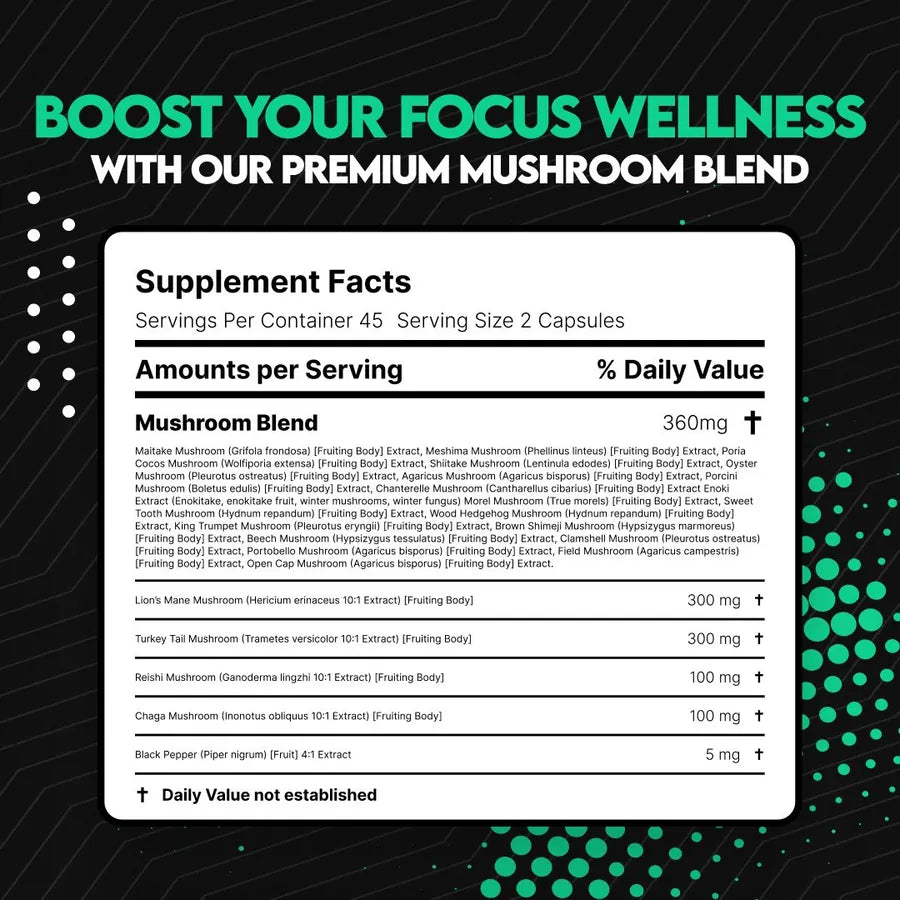
Here is a real label to compare against. One serving of Mushroom Blend is 2 capsules, with 45 servings per container:
- Reishi (Ganoderma lingzhi) 10:1 extract, fruiting body: 100 mg
- Lion's mane (Hericium erinaceus) 10:1 extract, fruiting body: 300 mg
- Turkey tail (Trametes versicolor) 10:1 extract, fruiting body: 300 mg
- Chaga (Inonotus obliquus) 10:1 extract, fruiting body: 100 mg
- 19-mushroom fruiting body blend: 360 mg
- Black pepper (Piper nigrum) fruit 4:1 extract: 5 mg
The four extracts and the 19-mushroom blend add up to the 1,160 mg of mushrooms per serving. Note that the 19-mushroom blend is one line at 360 mg, so the amount of each of those 19 is not split out. Any blend with a similar structure works the same way, so do the sum yourself.
What to look for in testing and sourcing
Third party testing means an outside lab checked the product, and a batch-specific certificate of analysis (COA) shows what that lab found for the lot you are holding.
That matters because supplements can carry contaminants. In one survey of 277 dietary supplement samples from the UAE market, three samples (1.1%) exceeded the acceptable daily intake for cadmium, lead and arsenic [1][2]. That is one market and one study, but it shows why a lab report beats a promise. Look for a COA tied to a lot number, a named lab, and results for heavy metals.
Organic and Made in USA are useful signals about farming rules and origin. They do not tell you the mushroom amount, the part used, or whether a batch was tested for contaminants. Treat them as extras, not substitutes for a lab report.
Which type fits you: single mushroom, blend, coffee, or gummies
Choose a single mushroom if you want one species at a set dose, a blend if you want broad coverage in one routine, coffee if you want a caffeine swap, and gummies if you will not take capsules.
- Lion's mane: best for people who want a single species focused on calm focus. See our Lion's Mane Mushroom guide, or the best lion's mane supplement picks.
- Reishi: best for people who want an evening routine focused on calm and a healthy response to stress.
- Cordyceps: best for people who want a morning or pre-activity routine.
- Chaga: best for people who want it as part of a broader immune-support routine.
- Turkey tail: best for people who want a gut and immune-support focus.
- Blends: best for people who want one simple routine covering many species.
Mushroom coffee or supplements? Coffee adds caffeine and often a small amount of mushroom per cup, while capsules give a set amount with no caffeine. If you are cutting caffeine or want a measured amount, choose capsules.
Cost per serving: how to compare fairly
Divide the price by the number of servings, then divide again by the milligrams of real mushroom in each serving.
Step one: price divided by servings gives cost per serving. Step two: divide that by the mushroom milligrams per serving, which gives cost per milligram. Step three: adjust for extract ratio, because a 10:1 extract is more concentrated than raw powder. Here is a worked example with placeholder numbers: a $45 bottle with 45 servings is $1.00 per serving. If each serving has 1,160 mg of mushrooms, that is about $0.00086 per mg. A $45 bottle with 45 servings and 400 mg of mostly grain-based powder per serving costs the same per serving, but about $0.0025 per mg of product, and less of it is mushroom. The prices here are made up for the math. Use the real price of any bottle you are considering.
Side effects and what not to combine
Mushroom supplements are usually well tolerated, but digestive upset is the most common complaint, and some mushrooms need a conversation with your doctor first.
Common issues include an upset stomach, gas or loose stools, especially when you start. Taking capsules with food can help. A 2024 systematic review looked at benefits, side effects and uses of Hericium erinaceus (lion's mane) as a supplement [3]. A separate 2024 acute, randomized, placebo-controlled, double-blinded, cross-over study investigated an acute dose of a mushroom ingredient [4]. Research on mushrooms in people is still limited, so keep expectations modest and start low. For amounts, see how much lion's mane is too much.
Reishi deserves extra care. If you take blood thinners or immune-related medication, or you have surgery coming up, talk to your doctor or pharmacist before using it. The same goes for blends that contain it. If you are pregnant or nursing, ask a professional first.
Where Mushroom Blend fits
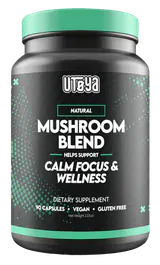
Mushroom Blend is a capsule blend for people who want one routine covering many species, with extracts included.
| Label fact | Detail |
|---|---|
| Mushrooms | 23 functional mushrooms in two capsules |
| Extracts | 10:1 extracts of lion's mane, turkey tail, reishi and chaga |
| Blend | 19-mushroom fruiting-body blend |
| Added | Black pepper extract |
| Per serving | 1,160 mg of mushrooms (2 capsules, 45 servings per container) |
| Why people take it | Helps support a healthy immune system, calm and a healthy response to stress, gut health, and calm focus |
Suits: people who want a one-capsule-routine covering many species, with extracts included.
Pick something else if: you want a single species at a high stated dose, you want a coffee format, you prefer gummies or powder, or you take blood thinners or immune-related medication (ask your doctor first).
Questions buyers ask
Are there any mushroom supplements worth taking?
Yes, if the label shows named species, fruiting body, a stated extract ratio, a disclosed amount, and a batch lab report. Human research is still limited, so expect support for normal functions, not dramatic changes.
What is the downside of lion's mane?
The most commonly reported downside is mild digestive upset. Start with a lower amount, take it with food, and talk to a doctor or pharmacist if you take medication.
What should you not mix reishi with?
Talk to your doctor or pharmacist before combining reishi with blood thinners or immune-related medication, and before surgery.
Is mushroom coffee or a mushroom supplement better?
Capsules are better if you want a set amount and no caffeine, and coffee is better if you want one drink to replace your usual cup.
How long before people usually notice anything from a mushroom supplement?
Many people take them daily for a few weeks before judging, and some notice nothing. Subtle effects are hard to tell apart from routine changes, so give it a steady trial.
Where to start
Check the label for part used, amount per serving and a lab report, then choose a format you will actually take every day.
These statements have not been evaluated by the Food and Drug Administration. This product is not intended to diagnose, treat, cure, or prevent any disease.
Sources
- Nature 2020, Nature Scientific Reports
- study author 2020, PubMed Central
- PubMed 2024, PubMed
- study author 2024, PubMed Central
About the author: John Crawford, Head of Products at Utoya Wellness. John has worked in supplements for 8 years and leads product sourcing at Utoya Wellness.
Caffeine-free daily formula with L-tyrosine, L-theanine & phosphatidylserine.
- One-time
- $39.99
- Subscribe & save 20%
- $31.99 / month
*These statements have not been evaluated by the Food and Drug Administration. This product is not intended to diagnose, treat, cure, or prevent any disease.


