

How Much Lion's Mane Is Too Much? A Plain Guide
By the Utoya Wellness team · · 8 min read

Quick answer
There is no official upper limit for lion's mane. Supplement guides commonly cite about 500 to 3,000 mg a day, and the best amount is the lowest one that works for you. More is not always better, and stomach upset is the most commonly reported sign of taking too much. Human data on high amounts is thin, so stay within the directions on your label and raise your amount slowly.
There is no official upper limit for lion's mane. More is not always better, and stomach upset is the most commonly reported sign of taking too much. Human data on high amounts is thin, so stay within the directions on your label and raise your amount slowly.
The short answer: how much lion's mane is too much
Nobody has set an official ceiling, so "too much" is the point where your body tells you it is more than suits you.
A sensible start is the low end of that range, or the serving on your label. Hold it for a couple of weeks before you change anything.
Stomach upset is the most reported sign of overdoing it. That can look like nausea, bloating or loose stools. Here is where human data stops: we do not have a trial that found a point where lion's mane becomes unsafe, and we do not have one showing that higher amounts work better. So the practical rule is simple. Take the lowest amount that gives you the result you want.

What the research has tested, and where the data stops
Human trials on lion's mane are few, small and short, and nothing tested defines a ceiling.
Much of the dose logic you see online borrows from animal and lab work. That work is useful for understanding how the mushroom behaves, but it does not tell you what a person should take. Lab and animal amounts do not translate neatly into a daily capsule count.
What this means for you: a missing ceiling is not the same as proof that any amount is fine. It means the evidence has not reached that question yet. The most reliable guidance is to follow the label directions on the product you use, and not to go above them without a reason and a conversation with a pharmacist or doctor.
Typical daily ranges by goal and form
The amount that makes sense depends on the form you use, because milligrams of raw powder, extract and fresh mushroom are not equal.
| Form | How it is usually dosed |
|---|---|
| Dual extract | Usually lower amounts, since extracts are concentrated; follow the product label |
| Capsule | Set by the label serving, commonly one to a few capsules a day |
| Tea | Varies widely with how much mushroom you steep and for how long |
| Fresh mushroom | Eaten as food, in portions like any other mushroom |
These are general ranges, not prescriptions. Concentration matters as much as the number on the front. A small amount of a strong extract can be equal to a much larger amount of plain powder.
Why the milligrams on a label can mislead you
Two products that both say "1,000 mg" can contain very different amounts of actual lion's mane fruiting body.
Here is why. Extract ratios such as 8:1 or 10:1 mean a large amount of raw mushroom was used to make a smaller amount of extract. A 10:1 extract is far more concentrated than plain powder at the same weight. Fresh mushroom is mostly water, so in general terms it takes many times the weight of fresh mushroom to equal a dried serving.
Mycelium grown on grain adds another wrinkle. The grain is part of the finished powder, so a serving can be large in milligrams while holding less of the mushroom itself. Some labels also list several blends, each with lion's mane. If you take a nootropic blend and a separate lion's mane capsule, you may be doubling up without noticing.
How to read a supplement facts panel in three checks
Three quick checks tell you what you are actually getting.
- Check the source part. Look for fruiting body, mycelium, or both. Mycelium on grain is worth a closer look.
- Check whether the amount is raw powder or extract. If it is extract, look for the ratio.
- Check serving size against capsule count. A label amount often covers a serving of two or more capsules, not one.
Then scan every other product you take for lion's mane in a blend.
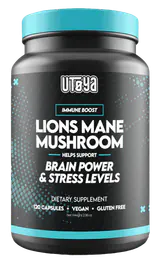
Our label: 1,000 mg per 2-capsule serving
Our Lion's Mane Mushroom provides a full 1,000 mg in every 2-capsule serving.
It is organic lion's mane in its most complete form: fruiting body, mycelium and extracellular compounds. You can read more in our Lion's Mane Mushroom guide, or see the Lion's Mane Mushroom capsules page.

Signs you may be taking more than suits you
The usual signs are digestive, and they are a cue to lower your amount rather than push through.
| What you notice | Likely cause | What to do |
|---|---|---|
| Nausea | Amount too high, or taken on an empty stomach | Take it with food, or lower the amount |
| Bloating | Amount too high, fillers, or stacking with other supplements | Lower the amount and check other products for overlap |
| Loose stools | Amount too high, or stacking | Step back to your last comfortable amount |
| Stomach discomfort | Empty stomach, or too much at once | Take with a meal, or split the amount |
| Itching or rash | Possible allergy or sensitivity | Stop and talk to a doctor |
The stop rule is simple: if you get itching or a rash, stop taking it and talk to a doctor. For anything milder, pause or step down and see whether it settles.
A simple way to find your amount
Start at a low amount, raise it in small steps, hold each step for about two weeks, and keep notes.
This works because it lets you tell the difference between a real effect and a coincidence. Changing several things at once makes that impossible. A simple log has one row per week. You do not need to reach the last one.
- Week and step: which amount you took.
- When you took it: morning or later, with food or not. See the best time to take lion's mane.
- Focus and memory: any change you notice, in your own words.
- Digestion: any nausea, bloating or loose stools.
- Other things: new supplements, caffeine, poor sleep.
Stop rule: if you notice digestive upset, go back to the last amount that felt fine. If you see itching or a rash, stop and talk to a doctor. If a higher step adds nothing, stay at the lower one.
Who should check with a doctor first
Talk to a doctor or pharmacist first if you have a mushroom allergy, are pregnant or nursing, take blood thinners or diabetes medication, or have surgery scheduled.
Bring the bottle to a pharmacist. The supplement facts panel gives them the serving size and the ingredients, which is what they need to check for overlap with your medications.
If you already use caffeine or a nootropic blend, add lion's mane on its own and hold everything else steady for a couple of weeks. That way, if something feels off, you know which change caused it. Also check whether your blend already contains lion's mane.
Daily use, cycling and how long to try it
Many people take lion's mane daily, but there is no standard cycling rule, and long term human data is limited.
A practical approach: give it several weeks at a steady amount, then reassess using your notes. If you feel a clear benefit, you can continue daily. Some people prefer to take breaks, for example a few days off each week or an occasional week off. Neither approach has been shown to be better. If you take a break and notice no difference, that is useful information too.
Lion's mane dosage FAQ
How much lion's mane should I take per day?
Raise it only if you want to, and only in small steps.
Can you take lion's mane every day?
Many people take it daily, and it is generally described as well tolerated, though long term human studies are limited, so reassess every few weeks.
What does lion's mane taste like?
Fresh, it is often described as mild and slightly sweet, with a texture similar to seafood, while capsules have no real taste to speak of.
Why do I feel weird after taking lion's mane?
The most common causes are too high an amount, taking it on an empty stomach, stacking with other supplements, or an individual sensitivity. Lower the amount and take it with food. If you notice itching or a rash, stop and talk to a doctor.
What should I avoid while taking lion's mane?
Avoid it if you have a mushroom allergy, and check with a doctor first if you are pregnant, nursing, on blood thinners or on diabetes medication.
These statements have not been evaluated by the Food and Drug Administration. This product is not intended to diagnose, treat, cure, or prevent any disease.
About the author: John Crawford, Head of Products at Utoya Wellness. John has worked in supplements for 8 years and leads product sourcing at Utoya Wellness.
Read more: best mushroom supplements brands.
Read more: organic mushroom blend.
Read more: nootropic mushroom.
Caffeine-free daily formula with L-tyrosine, L-theanine & phosphatidylserine.
- One-time
- $39.99
- Subscribe & save 20%
- $31.99 / month
*These statements have not been evaluated by the Food and Drug Administration. This product is not intended to diagnose, treat, cure, or prevent any disease.


