
Turkey Tail Supplement: What to Check Before You Buy
By the Utoya Wellness team · · 8 min read
Quick answer
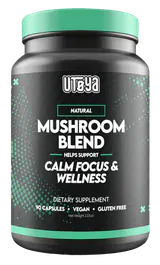
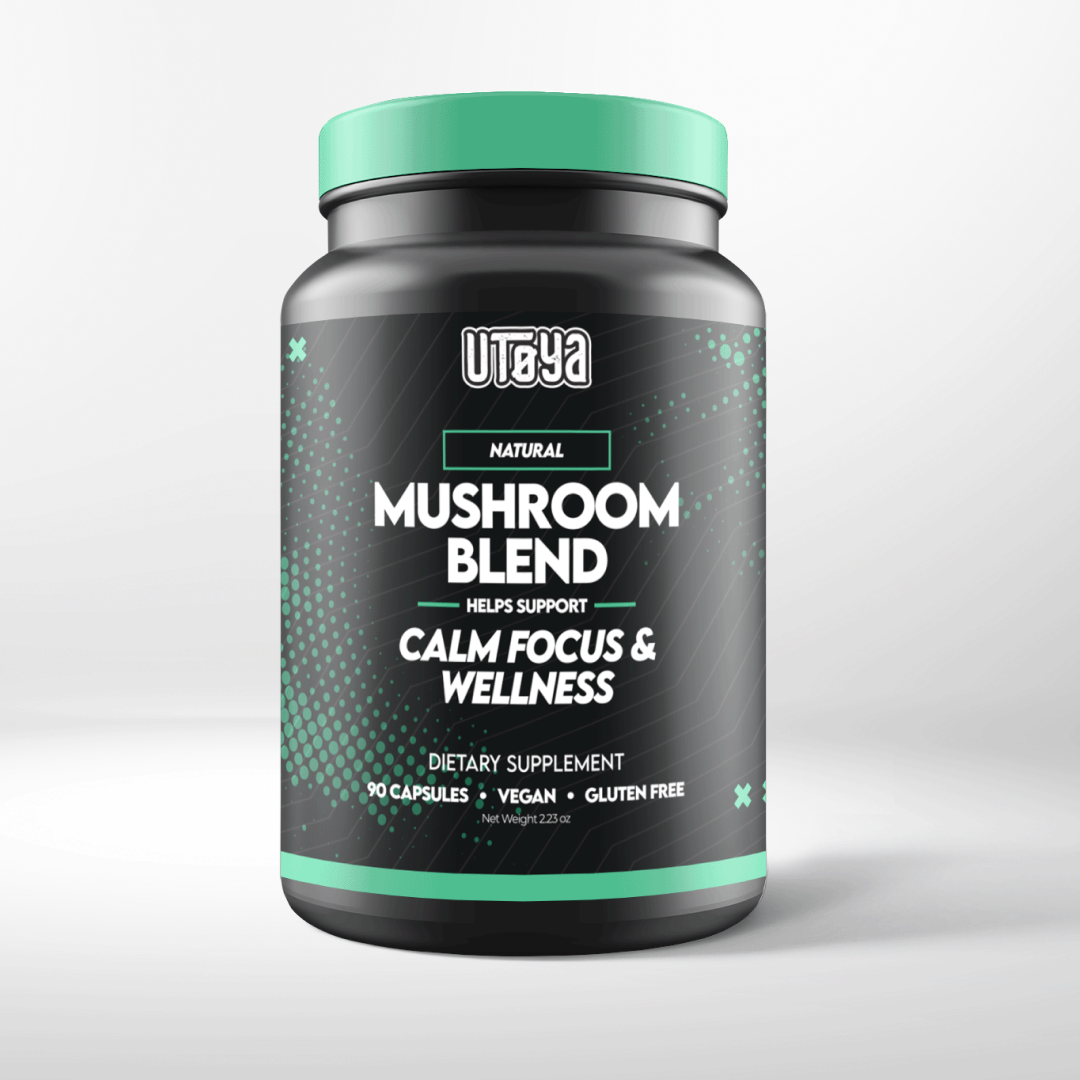
Turkey tail is Trametes versicolor. A good turkey tail supplement names the mushroom part (fruiting body or a clearly stated extract), states a beta glucan figure, shows third party testing, and comes in a form you will actually take daily. Utoya Wellness does not sell single-ingredient turkey tail. Mushroom Blend is a blend: 10:1 extracts of lion's mane, turkey tail, reishi and chaga plus a 19-mushroom fruiting-body blend, in two capsules. It suits people who want several mushrooms at once.
The short answer: what to look for in a turkey tail supplement
Look for five things: the species (Trametes versicolor), the part used, a stated beta glucan figure, third party lab testing, and a form that fits your day.
- Part used: fruiting body or a named extract, not an unlabeled "mushroom powder."
- Beta glucan: a stated percentage or amount beats marketing words.
- Testing: batch reports you can read.
- Form: capsules, powder or extract, whichever you will take consistently.
- Single or blend: pick the one that matches what you want from it.
Who each suits: choose a single-ingredient turkey tail if you want only that mushroom. Choose Mushroom Blend if you want several mushrooms in one serving.

What turkey tail is and what the label should tell you
Turkey tail is Trametes versicolor, a common bracket fungus sold as capsules, powder and extract.
The compounds most often discussed are beta glucans, including the protein-bound polysaccharides known as PSK and PSP. These are compounds that have been studied. That is not a promise of results from any retail product. A useful label tells you the species, the part used, the amount per serving and how many servings the container holds.
Compare the forms and criteria in one table
No single form wins every criterion, and our blend wins on breadth but loses on turkey tail specificity.
| Criterion | Single turkey tail capsules | Turkey tail powder | Concentrated extract | Mushroom Blend |
|---|---|---|---|---|
| Mushroom part used | Check label: fruiting body, mycelium on grain, or both | Check label: same options | Usually named on the label; confirm part | 10:1 extracts plus a 19-mushroom fruiting-body blend |
| Extract ratio and beta glucan | Look for a stated beta glucan figure | Look for a stated beta glucan figure | Ratio like 10:1 plus beta glucan figure | 10:1 extracts of lion's mane, turkey tail, reishi and chaga; a turkey tail only amount is not broken out here |
| Third party testing | Varies by brand; ask for batch reports | Varies by brand | Varies by brand | Ask the team for current reports (see our guide) |
| Form and convenience | Pre-measured, portable | Measure each time; mixes into drinks | Liquid or concentrate; measure each time | Two capsules per serving |
| Amount per serving | Read mg per serving and servings per container | Read mg per serving | Read mg or volume per serving | 1,160 mg of mushrooms per serving |
| Single vs several mushrooms | One mushroom | One mushroom | Usually one | 23 functional mushrooms in two capsules, plus a touch of black pepper extract |
| Who it suits | Want only turkey tail and a set amount | Want flexibility and do not mind measuring | Want a concentrated form | Want several mushrooms in one routine |
Everyone in the pregnant, nursing, medication or medical care groups should check with a doctor first, whatever the form.
Fruiting body vs mycelium on grain
The fruiting body is the mushroom you can see, while mycelium on grain is the root-like network grown on a grain base, which can leave starch in the final powder.
Beta glucan content is the figure to look for because it tells you something measurable about what is in the product. A stated beta glucan percentage plus a lab report says more than words like "organic" or "no fillers." To read a label, look for the phrase "mycelium on grain" or "myceliated grain," and check whether the label names grain, rice or oats as part of the powder. If a label never says which part was used, treat that as a reason to ask.

How to read an extract ratio like 10:1
A 10:1 extract means about 10 parts raw mushroom went into 1 part extract.
That tells you the extract is concentrated compared with the raw material. It does not tell you how much beta glucan is inside, and it does not guarantee potency. Use the ratio together with a stated beta glucan figure and a lab report. Mushroom Blend uses 10:1 extracts of lion's mane, turkey tail, reishi and chaga, alongside a 19-mushroom fruiting-body blend.
What human research on turkey tail actually shows
Human research on turkey tail is small, short and mostly done with specific extracts, so it does not show that any retail capsule works better than another.
- Safety and dose escalation (small phase I study): a two-center, dose escalation study was done to find the maximum tolerated dose of a Trametes versicolor preparation taken daily in divided doses [1]. It was a dose-finding design, not a test of everyday benefits [2].
- Gut microbiome (randomized, open-label, single center): a trial in healthy volunteers looked at polysaccharopeptide from Trametes versicolor and amoxicillin and their effects on the gut microbiome [3]. It was a single-center, open-label, randomized controlled trial [4]. The study used a specific polysaccharopeptide, not a retail capsule.
- Gut fermentation (laboratory): human fecal microbiota was cultured anaerobically to see whether it could ferment a common extract of T. versicolor, designated polysaccharide peptide [5]. This was a lab culture, not a trial in people.
The PSK work done in Japan is also part of this field, but we have not linked it here, so we do not describe its results. The takeaway: studied extracts are not the same as retail supplements, and no study here shows one form is better than another. Treat these findings as background on a compound being studied, not as a promise about any product.
Capsules, powder or extract: how each is taken
Capsules are the easiest to repeat daily, powder offers flexibility but needs measuring, and liquid extracts sit in between.
- Capsules: pre-measured, no taste, easy to carry. Mushroom Blend is two capsules per serving.
- Powder: mixes into coffee, tea or smoothies. You measure it, and the earthy taste comes through.
- Extract: concentrated, measured by scoop, dropper or serving size.
Follow the serving printed on the label. Compare milligrams per serving and servings per container rather than relying on a general dose you read online.
Turkey tail vs lion's mane (and other mushrooms) by goal
Neither mushroom is better in general; they are traditionally used for different goals, and research on both is still limited.
| Goal | Mushroom people often choose | What to know |
|---|---|---|
| Immune and gut interest | Turkey tail | Traditionally used here. Human studies are small and use specific extracts. |
| Focus and calm | Lion's mane | Traditionally used here. Check the label for the part used and amount. |
| Several goals in one routine | A blend | Mushroom Blend combines lion's mane, turkey tail, reishi and chaga extracts with a 19-mushroom fruiting-body blend. |
Mushroom Blend is positioned to help support a healthy immune system, calm and a healthy response to stress, gut health and calm focus.*
Who a single turkey tail suits, and who a blend suits
Choose single-ingredient turkey tail if you want only that mushroom and a specific amount; choose Mushroom Blend if you want several mushrooms in two capsules.
- Single turkey tail: best if you are comparing amounts of one mushroom or want to add or remove mushrooms one at a time. We do not sell one, so a brand that does is the right match.
- Mushroom Blend: best if you want lion's mane, turkey tail, reishi and chaga extracts plus a 19-mushroom fruiting-body blend in one serving, 1,160 mg of mushrooms per serving.
Skip or ask a doctor first if you are pregnant, nursing, taking prescription medicine or under medical care.
Safety, medications and who should talk to a doctor first
Talk to a doctor or pharmacist before using any mushroom supplement if you are pregnant, nursing, taking prescription medicines or under medical care.
This matters most with medicines that affect the immune system. Bring the product label with you so they can review every ingredient. Stop use and call a professional if you react badly.
Turkey tail for dogs: a short, careful note
Human supplements are not made for pets, so ask a vet before giving your dog any mushroom product.
Research in dogs is limited. A vet can advise on the right product and amount for your dog's size and health.
Frequently asked questions
What should I look for in a turkey tail supplement?
Look for Trametes versicolor named on the label, the part used, a stated beta glucan figure, third party lab testing and a form you will take daily. Then compare milligrams per serving and servings per container.
Which is better, lion's mane or turkey tail?
Neither is better overall; turkey tail is more often chosen for immune and gut interest, lion's mane for focus. A blend such as Mushroom Blend covers both in one serving.
Are turkey tail capsules or powder better?
Capsules are easier to take the same way every day, while powder gives flexibility but needs measuring. No study here shows one form is better.
Who should not take turkey tail?
Anyone pregnant, nursing, taking prescription medicines or under medical care should talk to a doctor or pharmacist first.
Can I give turkey tail mushrooms to my dog?
Ask your vet first, because human supplements are not made for pets and research in dogs is limited.
For more on our blend, read the Mushroom Blend complete guide.
FDA disclaimer
These statements have not been evaluated by the Food and Drug Administration. This product is not intended to diagnose, treat, cure, or prevent any disease.
Sources
- Torkelson 2012, International Scholarly Research Notices
- Torkelson 2012, International Scholarly Research Notices
- Veiga 2014, Gut Microbes
- Veiga 2014, Gut Microbes
- Pallesen 2013, PubMed
About the author: John Crawford, Head of Products at Utoya Wellness. John has worked in supplements for 8 years and leads product sourcing at Utoya Wellness.
Read more: chaga capsules.
Caffeine-free daily formula with L-tyrosine, L-theanine & phosphatidylserine.
- One-time
- $39.99
- Subscribe & save 20%
- $31.99 / month
*These statements have not been evaluated by the Food and Drug Administration. This product is not intended to diagnose, treat, cure, or prevent any disease.


